
Proposed: Replacing the Wine Club Binder With a Tablet That Works Without Wi-Fi
A proposed design for moving monthly club check-in at an independent market and wine shop off paper binders and onto a fast, offline-ready tablet tool.
Illustrative image generated for this page. A wine shop counter with a tablet; not a photo of the client.
Proposed work. This page describes a design I’ve proposed. It is not contracted, built, or live, and nothing here is a result.
In short: When a wine club member arrives for their monthly tasting, the person at the counter needs three answers fast: who is this, what do they get, and have they already had it? Where the answers live in paper binders, I’ve proposed a small tablet tool built around the server, with one job: find the member, tap once, move on. It keeps working when the Wi-Fi doesn’t.
The quiet failure
Picture a Saturday afternoon at the tasting counter. A club member gives their last name over the noise. The server starts turning pages in a binder, then asks, “Did you already do your tastings this month?” The member isn’t sure. Neither is the binder, because the last page was updated on a different shift.
Nobody is doing anything wrong. The problem is the tool:
- Paper doesn’t keep up with a busy counter. Members hold different tiers, some hold more than one membership, and the allocation resets every month.
- Lines form while the binder gets flipped. Every page turn is attention taken from the guest.
- The Wi-Fi isn’t on your side. In a busy cellar and tasting area the connection comes and goes, so a tool that needs a perfect signal fails at the wrong moment.
- Hospitality loses. Staff flipping pages aren’t recommending a bottle or asking how last month’s wine went.
What I’ve proposed
I started with the server, who has a line behind the guest and no free hands. Every decision comes back to one test: does this make the next ten seconds easier?
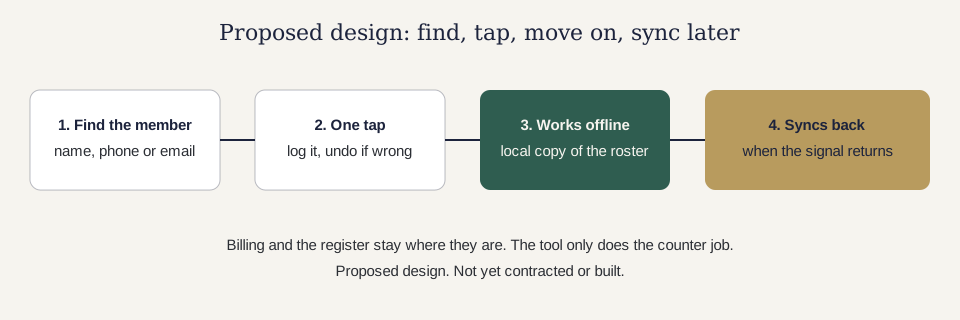
- Find a member in seconds. Search by name, phone, or email, running on the tablet itself so results appear without waiting on a connection.
- Tap once and move on. A single tap records a tasting or a bottle pickup, with a clear confirmation and an undo for the inevitable wrong tap.
- Keep working offline. A local copy of the club roster lets staff keep checking members in if the connection drops mid-rush, syncing in the background when it returns.
- Fit the systems already there. The shop keeps its existing club billing and register. The tool only does the counter job.
- A manager view for afterward. Review check-ins and export usage reports, with a quick personal PIN so each action ties to a person.
Why a dedicated tool
Business software is built for bookkeeping and reporting. A tasting counter needs speed, clarity, and reliability under pressure. The better answer is a separate, small tool made only for the counter, connected to the systems that handle the money.
The tradeoff
A paper binder has one real virtue: it never needs charging. A tablet tool adds devices to keep charged and updated, a monthly roster import, and someone to call when something acts up. That is why I’d design these tools with a plan for ongoing support, so the venue gets the speed without becoming an IT shop.
Questions worth asking about your club counter
- How long does it take staff to confirm what a member is owed this month?
- What happens at the counter when the Wi-Fi drops?
- Could a new hire run check-in correctly on their first weekend?
If those answers make you wince, the counter is working against your team.
Want your club counter to move faster?
Start with a free intro call. We’ll talk through how your club runs today, where the counter slows down, and what a better tool could look like. No sales script.
Have a similar challenge?
Every engagement starts with a free intro call, then a scoped audit if it makes sense.
Book an Intro Call