My Head Somm
An independent product I built to explore how AI can improve the guest wine experience without flattening it into generic chatbot output.
Why I built it
I built My Head Somm as an independent product, not a client project.
The problem I wanted to explore was familiar: most guests want help choosing wine, but they do not want to read a database or decode tasting jargon while sitting at a table. They want confident guidance that feels human, fast, and context-aware.
That makes this project much more relevant to my core work than a generic consumer app. It let me test how AI, structured recommendations, and hospitality-aware UX could support discovery without getting in the way of service.
What I built
My Head Somm handles the decision load of wine pairing through:
Dual Pairing Modes: “Pair My Meal” takes a dish description, wine color, style, price tier, and varietal preferences and returns curated recommendations with rationales. “Pair My Wine” works in reverse — input a bottle and get food pairings by course.
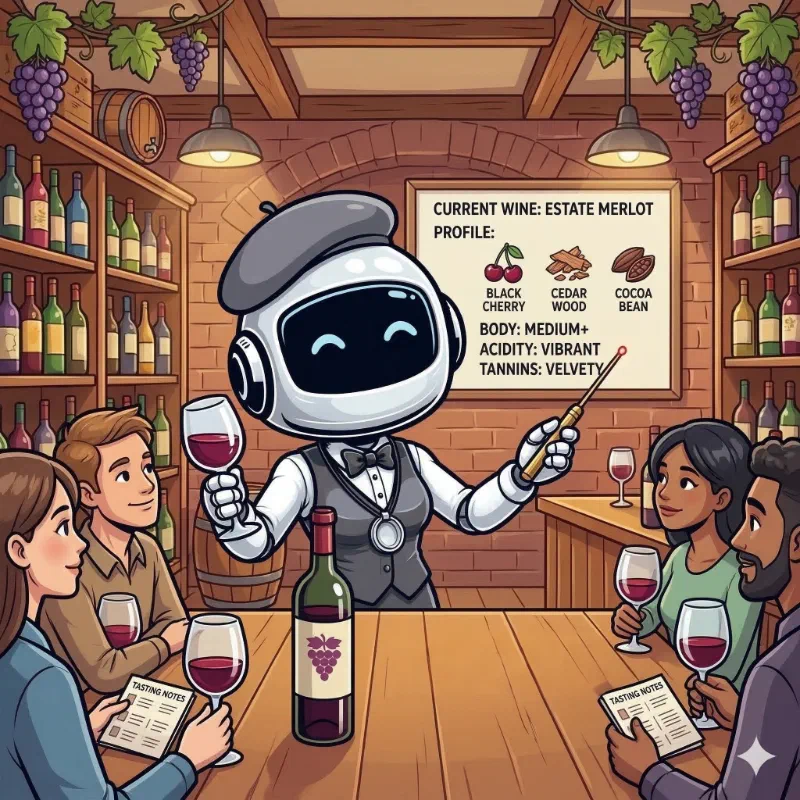
The Decantrix Persona: Every interaction is guided by Decantrix, an AI sommelier persona that speaks in sensory, confident language. Not a generic chatbot — a character with a voice, a worldview, and the calm authority of someone who has tasted widely and studied deeply.
My Cellar — Offline Tasting Notes: A private, offline-first journal built to WSET professional standards. Users record appearance, nose, palate, and conclusion for every wine, stored locally on the device. No account required. No data leaves the phone.
Why it matters
This project is still not a substitute for winery client work. It does not prove that I have already solved your exact tasting room workflow for a venue like yours.
What it does prove is more specific and useful than a vague innovation claim:
- I understand the guest side of the wine experience. The app is built around hesitation, confidence, mood, and context, not just data.
- I can translate hospitality nuance into software. The recommendation format, persona design, and offline journal are product choices shaped by how people actually engage with wine.
- I can build reusable digital concepts. The logic behind this app could inform tasting room tools, staff enablement, event experiences, or educational workflows.
The design
My Head Somm is designed for the environment where it’s used — low-light dining rooms and tasting bars. Dark mode is the default. Typography uses Playfair Display for a refined editorial feel. Haptic feedback confirms saves and interactions without pulling attention from the table.
The persona integration goes beyond copy. Loading states say “Consulting the archives…” Pairing results include “The Decantrix Secret” — contextual sommelier tips on serving temperature, decanting time, and glassware. The goal was to make the app feel less like software and more like a quiet conversation with someone who knows wine.
How It’s Built
A few things that matter to operators, translated out of technical language:
It works on bad restaurant Wi-Fi. The pairing engine calls the AI; the tasting journal doesn’t. If the connection drops mid-service, guests can still log notes. Nothing is lost.
No account required. Tasting notes live on the guest’s phone. Nothing is uploaded, synced to a server, or tied to an email address. That’s a feature, not a limitation — guests in a tasting room don’t want to create another login.
The AI gives consistent answers. It isn’t generating free-form text that varies unpredictably. Every pairing recommendation follows a structured format — varietal, rationale, serving notes — so the experience is the same whether a guest uses it Tuesday afternoon or Saturday night at capacity.
No ads, no tracking, no third-party data collection. The same philosophy behind My Head Chef: build a tool that does what it says, then get out of the way.
Why this matters for hospitality
My Head Somm isn’t just a consumer app — it’s a proof of concept for how AI can serve the hospitality industry without replacing the human element.
For operators, the implications are practical:
Tasting room staff can use the pairing engine to support guests during busy pours when the most experienced team member is already occupied.
Wine bar owners can point curious guests to the app instead of printing pairing guides that go stale the moment the by-the-glass list changes.
Wine club managers can see how AI-assisted discovery deepens brand loyalty — members who understand what they’re drinking tend to stay longer and buy more.
The Decantrix persona was designed to be reusable across hospitality contexts: tasting room kiosks, event experiences, educational tools, and menu-planning systems. The character is consistent; the deployment is flexible.
Where it fits in my portfolio
I include My Head Somm here because it is honest evidence of how I think and build. It shows initiative, product taste, and technical range in a domain adjacent to the operators I work with.
It should not carry the same weight as a client case study like Uncorked. It is supporting credibility: proof that I can build guest-facing tools in hospitality, not proof that I am padding a client roster.
Project Specs
- Platform: iOS — free on the App Store. Android coming soon.
- Intelligence: Google Gemini — structured pairing recommendations, not open-ended chat.
- Persona: Decantrix — custom AI sommelier character.
- Tasting Journal: Offline, private, WSET-standard fields. No account required.
- Philosophy: Builder-led, utility-first, hospitality-native.
Have a similar challenge?
Every engagement starts with a fixed-price DTC audit and 90-day roadmap.
Book a Discovery Call