Building an AI Planning Assistant Clever Parties Can Put Its Name On
How Clever Parties, a founder-led experience brand, turned a promising AI demo into a planning tool it can put in front of guests.
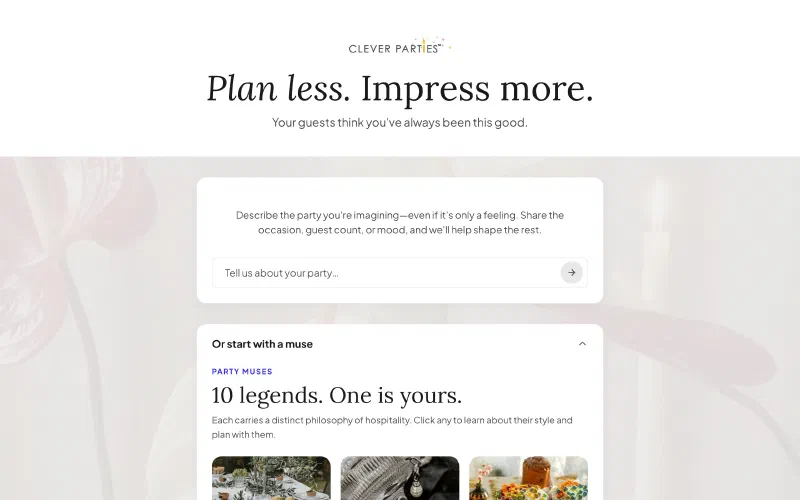
The public Clever Parties planning page. Screenshot taken 2026-10-20.
In short: AI is excellent at mood, flavor, and conversation. Left alone, it is also happy to plan a seven-course dinner for twelve in a galley kitchen. I built a planning assistant for Clever Parties, an experience brand, where the AI handles the creative conversation and ordinary software checks what has to be right. The assistant is live and phase 1 is complete. This page describes the approach at a high level, and results are not yet measured.
The gap between a demo and a product
Clever Parties’ founder has spent years getting the details of a gathering right: the table, the pacing, the opening pour. The idea was to put that point of view into a conversational tool. A host describes the evening they have in mind, and the tool returns an evocative plan.
Early testers loved it. As a product, the prototype had a familiar problem: it was creative, but it wasn’t yet safe to put in front of guests. One bad experience is enough to sour a guest on a young brand, so the goal was to keep the creativity and remove the risk.
The core idea: the AI suggests, the software decides
A language model is a superb creative partner and a poor referee. It won’t reliably count courses, honor a dietary need, or size a menu to the number of guests.
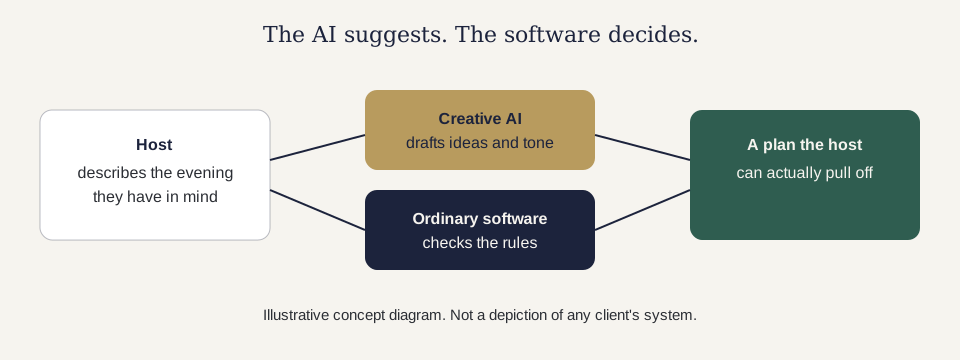
So the work splits in two. The AI listens to the host and drafts ideas. Regular, tested software around it checks the rules and decides what gets through. The magic stays in the writing, and the reliability lives in the code.

How the build approaches it
- A conversation with momentum, not an interrogation.
- Big ideas brought down to size, so a host can pull off the evening in their own space.
- Taste that sounds like the brand. Getting the assistant to sound like one particular founder took more work than the rules did, and it was a collaboration rather than a setting.
- Control stays with the founder, not a developer on call.
The tradeoff
An AI tool isn’t a brochure site you launch and forget. The underlying models change, and real hosts describe their parties in ways no one predicted. This kind of tool needs periodic tuning and a person watching it.
Where this applies beyond event planning
These are directions the approach fits, not finished products:
- A tasting-flight or pairing concierge that recommends from a venue’s actual inventory
- A weekend itinerary builder for a destination, winery, or vacation property
- A private-event inquiry assistant that gathers the details a manager needs before the first call
A question to ask any AI vendor
Where is the line between what the AI decides and what the software decides? If the answer is “the AI decides everything,” ask who is responsible when it is wrong.
Have an AI idea for your venue or brand?
Start with a free intro call. We’ll talk through what you want guests to experience and whether AI is the right tool for it. No sales script.
Have a similar challenge?
Every engagement starts with a free intro call, then a scoped audit if it makes sense.
Book an Intro Call