
The Omni-Channel Audit: A Systematic Look at Where Your Tasting Room Loses Revenue
You know something is off. Traffic is coming in, guests are having good experiences — but the conversion to club members is slower than it should be, and you can't tell which marketing is working.
The revenue leak in most tasting rooms isn’t dramatic. It’s a series of small gaps — a missing follow-up after a first visit, a checkout flow that doesn’t surface the club, a POS system that doesn’t talk to the email platform — that compound quietly over months.
Most operators I talk to know something is off. Traffic is coming in, guests are having good experiences, but the conversion to club members is slower than it should be, repeat visit rates feel soft, and it’s hard to know which marketing is actually working because the data lives in four different places and none of them agree.
That’s not a strategy problem. It’s a systems problem. And it’s solvable — once you can see the full picture.
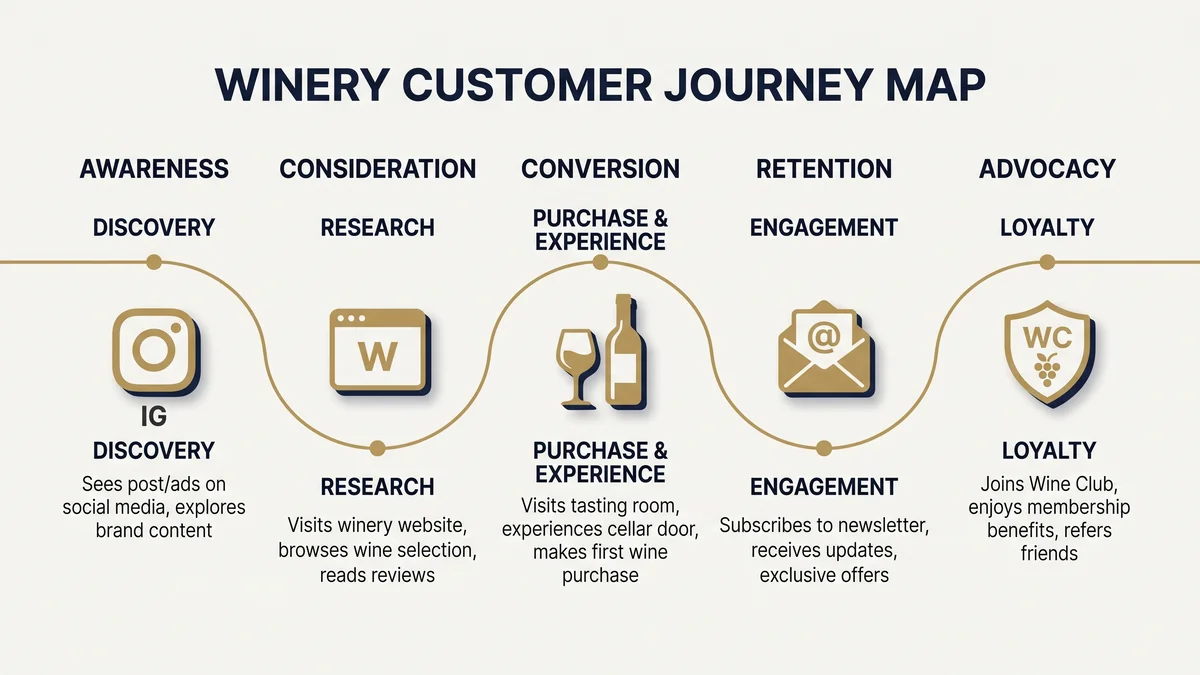
What an Omni-Channel Audit Actually Looks At
“Omni-channel” gets used as a buzzword. In practice it means: look at every place your guest interacts with your brand, map what happens at each touchpoint, and find where the handoff breaks.
For a tasting room, that typically covers:
Social media and paid ads. What are guests being asked to do after they see your content? Where does the link go? If they don’t act immediately and come back the next day, is there a path back in?
Website and landing pages. Does the page answer the question the post or ad raised? Is there a clear path to club signup or mailing list capture? How many clicks does it take to get there, and how many guests are willing to take each additional step?
Email and SMS. Is there an automated follow-up after a first visit? After a purchase? After someone signs up for the mailing list but hasn’t joined the club? If you’re treating your email list as a broadcast channel rather than a nurture sequence, you’re leaving the most cost-effective channel underworked.
POS and in-venue experience. Is the club being surfaced at the counter? Are purchases tracked in a way that feeds back into your email platform? Does the guest have a compelling reason to give you their contact information before they leave?
Club platform and CRM. Is all member data in one place? Can you see when someone lapses and automatically trigger an outreach? Can you tell the difference between a member who’s dormant and one who’s churned — and respond differently to each?
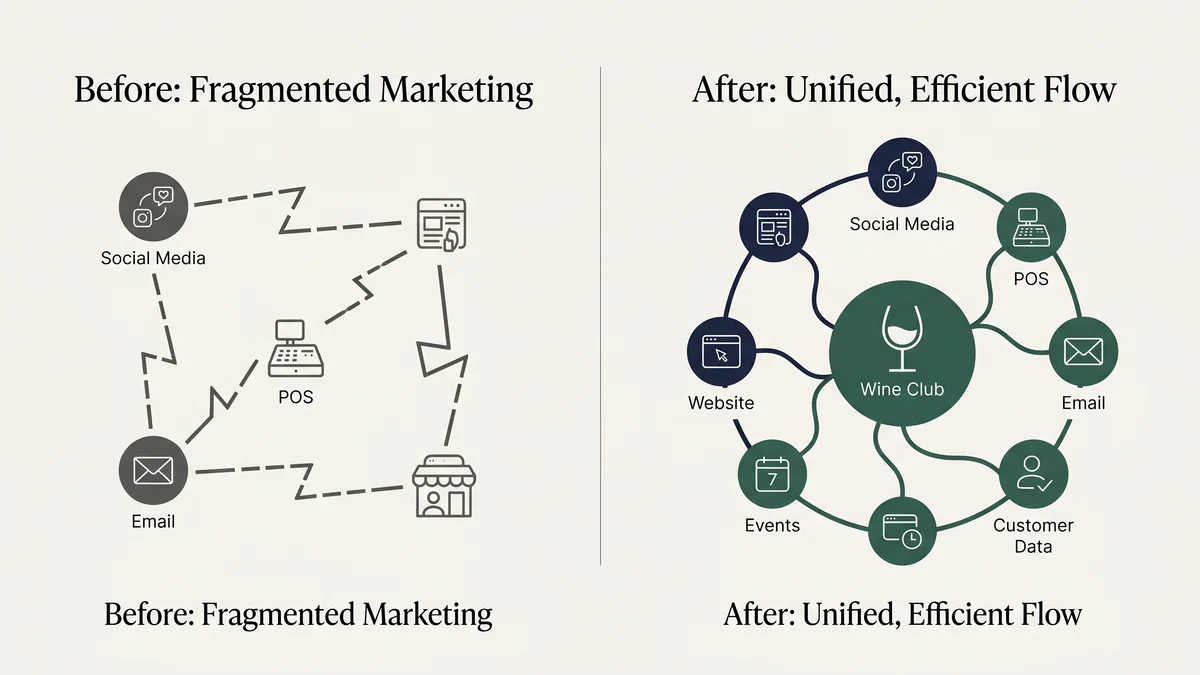
Most operators have some version of all of these. The gap isn’t having the tools — it’s that the tools aren’t talking to each other, and the moments where a guest was ready to go deeper quietly got missed.
What I’m Looking for When I Audit
The clearest signal of a revenue leak is a mismatch between a guest’s intent and the system’s ability to capture it.
A guest who clicks through from Instagram and lands on the homepage wasn’t given a reason to act. A new visitor who had a great experience but didn’t leave their email address can’t be followed up with. A club member whose subscription lapses and doesn’t receive any outreach is a quiet churn — preventable if the system was set up to notice.
I’ve mapped these flows for Fortune 500 companies. The categories are identical at a 200-guest winery — the scale is just different, and that’s mostly a relief.
The audit maps these gaps across four dimensions:
Channel coverage. Is every guest-facing channel accounted for, and does each one have a clear job? Not every channel needs to do everything. A Google Business post and an Instagram Reel have different audiences and different roles. Are they playing those roles, or just existing?
Funnel continuity. When a guest takes a step — clicks an ad, fills out a form, makes a purchase — does the next step follow automatically? Or does it depend on a staff member remembering to do something?
Data flow. Where does guest data go after it’s created? Is it in a system you can act on, or does it sit in a POS report that nobody pulls? If purchase history, email engagement, and club status each live in a separate platform, you don’t have a single guest view — you have three partial ones.
Attribution. Do you know which channels drive club signups? Which content leads to repeat visits? Which email sequences convert the most? If not, you’re allocating time and budget based on gut feel rather than evidence. That’s not a criticism — most operators are in this position. It’s just a gap worth closing.
Two Ways to Start
The free 5-minute Digital Leak Check is the fastest way to surface the biggest gaps. It’s a short, structured assessment that gives you a snapshot of where your digital operation stands today — which channels are working, which are underperforming, and where the most obvious disconnections are. It takes five minutes and costs nothing. Most operators come away with two or three things they can act on immediately.
The paid Omni-Channel Audit goes further. It includes a full touchpoint map of your guest journey, a written findings report with prioritized recommendations, and a direct working conversation to walk through what to fix first and why. It’s designed for operators who want to understand the scope of the problem clearly before deciding how to address it — and who want a second set of eyes on the whole system, not just one channel.
The audit is also the natural starting point for operators considering a retainer engagement. It gives me the context I’d need to scope that work well — where the gaps are, which ones matter most, and what fixing them is actually worth.
Who This Is For
The audit makes the most sense for operators who are investing in social, email, or paid advertising but can’t connect that activity to club signups or repeat visits. Or who have a club program but struggle to articulate what’s driving growth or churn. Or who use multiple platforms — POS, email, CRM, social, website — and know they don’t connect cleanly, but haven’t had the time or the outside perspective to map the full picture.
It’s also a fit for operators who are starting a club program from scratch and want to set the foundation up correctly before the data gets messy and the disconnections become habits.
If you’ve been running your operation on instinct and it’s working reasonably well — but you sense there’s a gap between what you’re putting in and what you’re getting out — the checkup is the right first step. It either confirms you’re in better shape than you thought, or it shows you exactly where to look.
The Bottom Line
No tasting room leaks revenue intentionally. The gaps that cost operators real money — missed club conversions, lapsed members, unattributed first visits that never became regulars — are almost always the result of systems that were set up separately and never connected. The audit doesn’t fix all of that in one conversation. But it tells you what to look at first, and that tends to be the most valuable thing.
How this fits the engagement model
The Omni-Channel Audit is designed as a starting point, not a standalone engagement. The findings map directly onto the work covered by a Digital Operations Partner retainer — fixing the email gaps, connecting the CRM, cleaning up the funnel architecture. Operators who do the audit first arrive at that conversation with a clear picture of what to prioritize, which makes the engagement more focused and the results faster to see.
Everything that comes with this service.
Full Touchpoint Map
A documented map of every channel your guests interact with — social, website, POS, email, CRM, and club platform — with the handoffs and gaps between each one made visible.
Funnel Continuity Review
An honest assessment of which steps in your guest journey happen automatically and which depend on staff memory or manual action. Every manual step is a potential gap.
Data Flow Diagram
A plain-language diagram showing how guest data moves (or doesn't) between your tools — and where single-guest view breaks down into three partial ones.
Revenue Leak Estimate
A conservative estimate of what disconnected systems are costing in missed club conversions, lapsed members, and first visits that never became regulars.
Prioritized Findings Report
A written report ranking gaps by revenue impact and implementation effort. Not a list of everything broken — a clear starting point ordered by what to fix first.
Working Session
A direct conversation to walk through findings, answer questions, and agree on where to start before any execution begins. You leave with a clear next step, not homework.
Ready to plug the leaks?
Every engagement starts with a fixed-price DTC audit. You'll know what's broken before you spend a dollar on execution.
Book a Discovery Call