What a Custom Member Platform Actually Costs (And What Off-the-Shelf Really Costs You)
The software your wine club is running on is probably costing you more than the monthly invoice.
The software your wine club is running on is probably costing you more than the monthly invoice.
There’s the subscription fee — Commerce7, WineDirect, or whichever platform you’re on. That number is visible. But there’s also what the platform can’t do, and what that limitation quietly costs in guest experience, staff time, and member churn. Those costs don’t show up on an invoice. They show up in conversion rates, lapse rates, and the amount of time your staff spends on manual workarounds during a Friday rush.
When I built the Uncorked Wine Tastings member platform — a full system covering a member mobile app, web portal, staff admin tool, and serverless backend — the entire stack runs for less than $20 a month at early-stage membership volumes. That’s not a teaser rate. That’s the actual operational cost of a purpose-built system handling the same jobs as a platform charging $300–600/month before per-transaction or per-member pricing is added.
Nearly 30 years of enterprise architecture teaches you two things: what genuinely needs to be robust, and what is only expensive because someone sold you on it. This platform was designed from the first commit to avoid the second category.
What Off-the-Shelf Software Gets Wrong
Generic wine club platforms were built for the average use case. They handle it reasonably well. The problem is that your operation probably isn’t average.
It handles payments or content — rarely both. Most platforms manage subscription billing or member communication. Connecting those two things — so the system that processes renewals also sends push notifications and surfaces member benefits — typically requires a second tool, a paid integration, or a workaround that someone on your team maintains manually.
It creates friction at the counter. When staff need to verify a member’s eligibility for a tasting or redeem a monthly benefit, the workflow depends entirely on what the platform allows. Some require a member login. Some require a separate staff-facing app. Some require a manual lookup. Every moment of friction during a busy flight service is a guest experience problem — and it’s a staff morale problem after the fifth time in one evening.
It doesn’t integrate with your POS. This is the gap I run into most often. Your POS knows what guests bought. Your club platform knows who’s a member. If they don’t talk to each other, you’re operating two separate, incomplete pictures of your guests — and making decisions based on each one in isolation.
The per-member costs compound. Platforms that charge per member or per transaction look manageable when your club has 30 members. At 150 members, the math changes. At 300, it changes again. If the platform uses tiered pricing, you may cross a pricing threshold before you’ve seen the revenue that justifies it.
What I Built for Uncorked — and Why
Uncorked Wine Tastings in Dublin, Ohio needed a membership platform that could handle club signups, process payments, verify member eligibility at the counter in real time, and give members something worth opening between visits.
I evaluated the off-the-shelf options first. Most handled one job. None integrated cleanly with the existing point-of-sale. And the ones that came close had per-member fees that would’ve eaten into margins before the program proved itself. So I built it instead.
Four connected applications, each with a specific job:
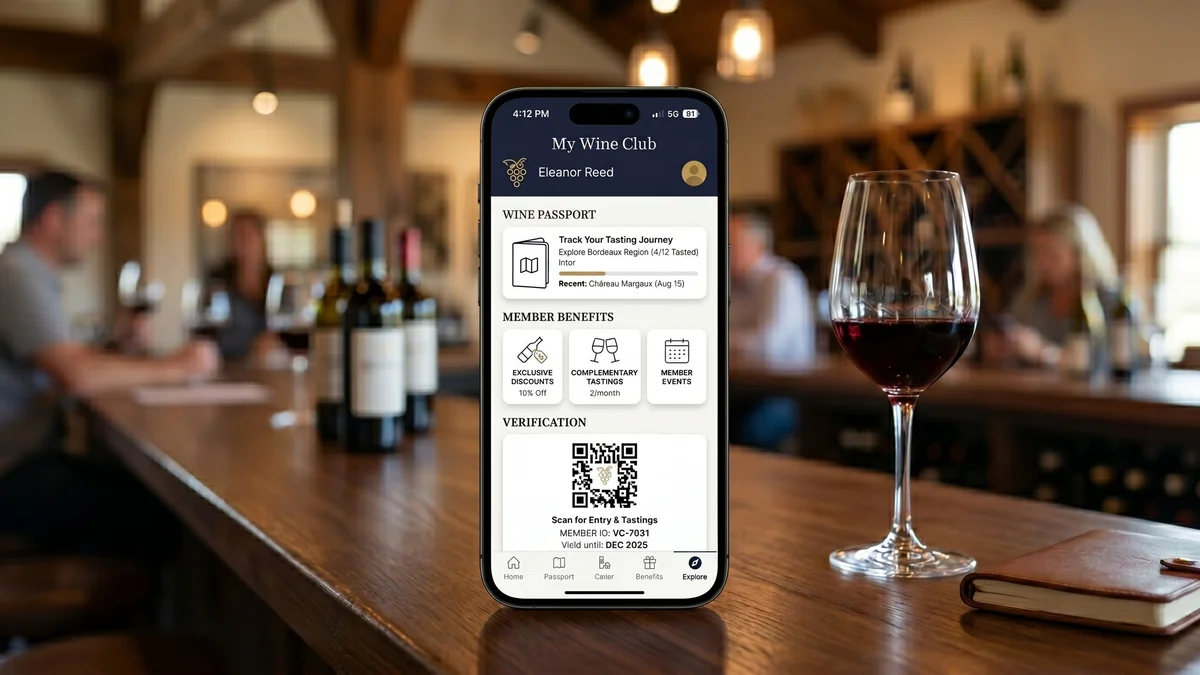
A mobile app for members — iOS, Android, and web — with a wine passport for tracking tastings, a receipt scanner that uses on-device processing to validate purchases, push notifications for announcements, an event calendar, a browsable wine list with tasting notes, and a membership tier comparison tool. The app works offline where it matters: announcements and wine data are cached locally, and receipt submissions queue up if the network drops.
A member web portal for signups and billing management. All payment handling goes through Stripe — no payment data stored locally. Authentication through Auth0. The portal stores nothing sensitive.
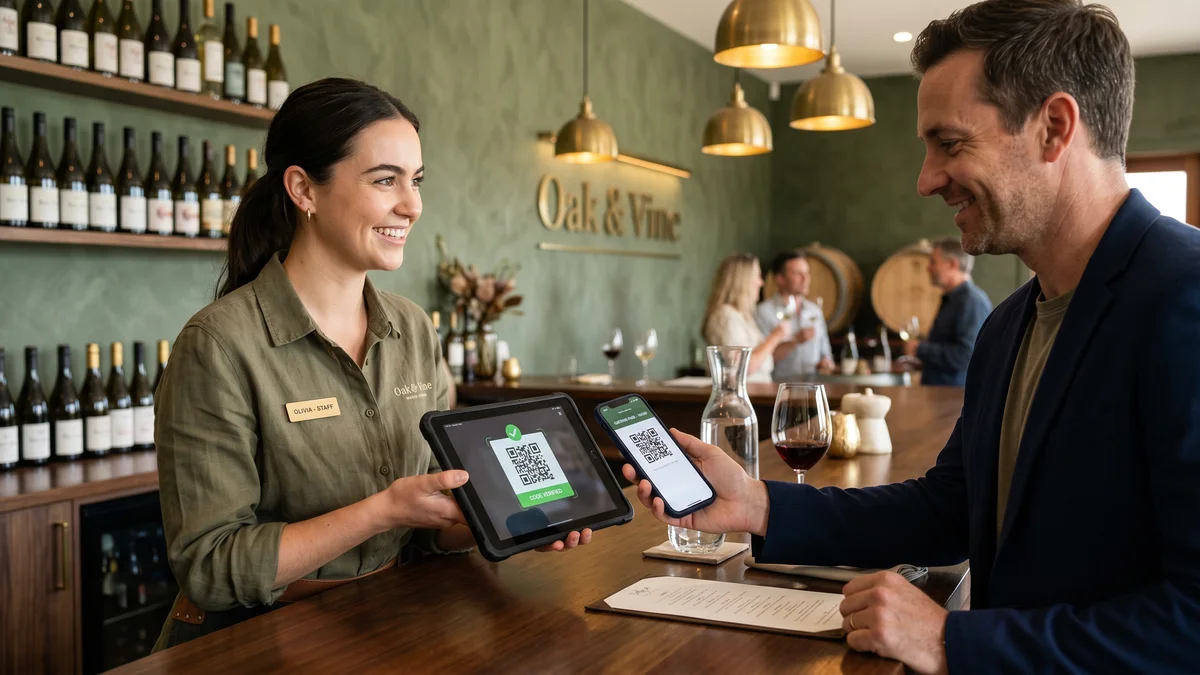
A staff admin tool that reads a member’s QR code, checks eligibility in real time (active status, tastings redeemed this month, tastings remaining), and marks a redemption with one tap. Touch-optimized, works on any device with a camera.
A serverless backend on Azure Functions that handles the business logic: Stripe webhook processing for subscription events, subscription state management, push notification orchestration, and monthly redemption tracking with concurrency control to prevent double-redemption.
Why It Costs Less Than $20/Month to Run
The architecture was designed specifically to cost almost nothing at low volume.
Azure Table Storage instead of a relational database: membership data is simple — a member record, a monthly redemption counter, push notification tokens. Table Storage handles this at near-zero cost with single-digit millisecond reads. Azure Functions on a consumption plan: the backend costs nothing when idle and scales automatically under load. On-device OCR for receipt scanning: no per-scan cloud API fees, works without a network connection.
There’s no vendor pricing model that will change on you next quarter. Stripe handles payments. Auth0 handles identity. Azure handles compute and storage. Each piece can be replaced independently if the economics change. That’s a different risk profile than being locked into a platform whose pricing you have no control over.
The Three-Year Cost Comparison
The economics of a custom build versus SaaS are most visible over a three-year window, which is a reasonable planning horizon for a membership platform.
A platform charging $400/month represents $14,400 over three years — before per-member or per-transaction fees. At 150 active members on a platform charging an additional $1.50/member/month, add another $8,100. Total: north of $22,000 over three years for a platform you don’t own, can’t modify, and will need to migrate off of if it stops serving your needs.
The Uncorked platform, at sub-$20/month operational cost after the build, runs to roughly $720 over three years in operational spend. The build is a front-loaded investment — that’s the honest tradeoff. But the comparison changes significantly when you factor in what the platform actually does versus what it costs at scale.
When a Custom Build Makes Sense
A custom platform isn’t the right answer for every operator. If your membership program is simple — a recurring discount and a monthly shipment, nothing more — a capable off-the-shelf platform is the pragmatic choice. I’ll tell you that directly.
A custom build makes sense when:
- Your use case doesn’t fit the mold: hybrid tasting credits, monthly shipments, event access, and in-venue verification in one system
- You want control over the guest experience, not just the billing workflow
- You’re doing the three-year math and the build investment compares favorably to compounding SaaS fees
- You want to own the system, not rent it — especially as your membership base grows
The other context where a custom build often makes sense: you’re launching the club from scratch. Setting it up right the first time is meaningfully less expensive than migrating an active member base off a platform that turned out to be the wrong fit.
The Bottom Line
Off-the-shelf wine club software solves a common problem for a common operation. If your operation is common, it’s probably fine. But if you’re running a venue with a specific guest experience in mind — and a membership program that’s supposed to be part of that experience, not just a billing process attached to it — it’s worth understanding what a purpose-built alternative actually costs before assuming it’s out of reach.
The Uncorked platform runs for less than a tank of gas per month. It does more than the alternatives I evaluated. And it will for as long as the business runs it.
How this fits the engagement model
A custom member platform is a capital investment, not a retainer service — but it becomes most valuable when the platform is connected to an ongoing operation. The operators who get the most out of a purpose-built system are the ones who also have someone managing the email flows, CRM data, and club health that the platform generates.
If you’re evaluating a custom build, that conversation is best had as part of a Digital Operations Partner engagement scoping — where I can assess whether a custom build is the right fit or whether an optimized off-the-shelf setup gets you further faster.
Everything that comes with this service.
Member Mobile App
Branded iOS and Android app with club benefits, pour history, event calendar, push notifications, and QR-based tasting redemption. Offline-capable for announcements and wine data where the network drops.
Member Web Portal
Signup, billing management, and account history — built on Stripe for payments and Auth0 for authentication. No sensitive data stored locally. Works on any browser.
Staff Admin Tool
QR-scan verification on any device with a camera. Checks active status, tastings remaining this month, and logs redemption in one tap. Touch-optimized for counter use during a busy service.
Serverless Backend
Azure Functions handling subscription state, Stripe webhook processing, push notification orchestration, and monthly redemption tracking with concurrency control to prevent double-redemption.
Three-Year Cost Model
A documented comparison of custom build vs. SaaS costs at your expected membership volume — so the investment decision is grounded in real numbers, not assumptions.
Migration Planning
For operators moving off an existing platform: data export, member communication strategy, and cutover planning designed to minimize disruption to active club members.
Ready to plug the leaks?
Every engagement starts with a fixed-price DTC audit. You'll know what's broken before you spend a dollar on execution.
Book a Discovery Call