From Platform to Partner: How My Pub Marketing Started — and Why It Changed
My Pub Marketing began in 2021 as a website platform for craft breweries. Here's how it evolved into a fractional digital operations practice for tasting rooms and DTC wine businesses.
In 2021, the craft beer market was still riding a decade-long wave. New breweries and taprooms were opening across the country, many of them run by small teams who were passionate about their product but stretched thin on everything else — especially their digital presence.
I noticed the same pattern over and over. A taproom owner would have a Facebook page, maybe an Instagram account, and a website that was either built five years ago by a friend or assembled in a weekend on a generic site builder. The hours were wrong. The menu was out of date. The “About” page was a placeholder. And every time a customer searched for the business online, what they found didn’t match the experience waiting for them at the bar.
That gap — between the quality of the hospitality and the quality of the digital presence — is what My Pub Marketing was built to close.
The original product
I founded My Pub Marketing in 2021 as a hosted website platform designed specifically for breweries, taprooms, pubs, and bars. The idea was simple: give venue operators a professional, branded website that worked out of the box for their specific needs, without requiring them to learn web development or manage hosting.
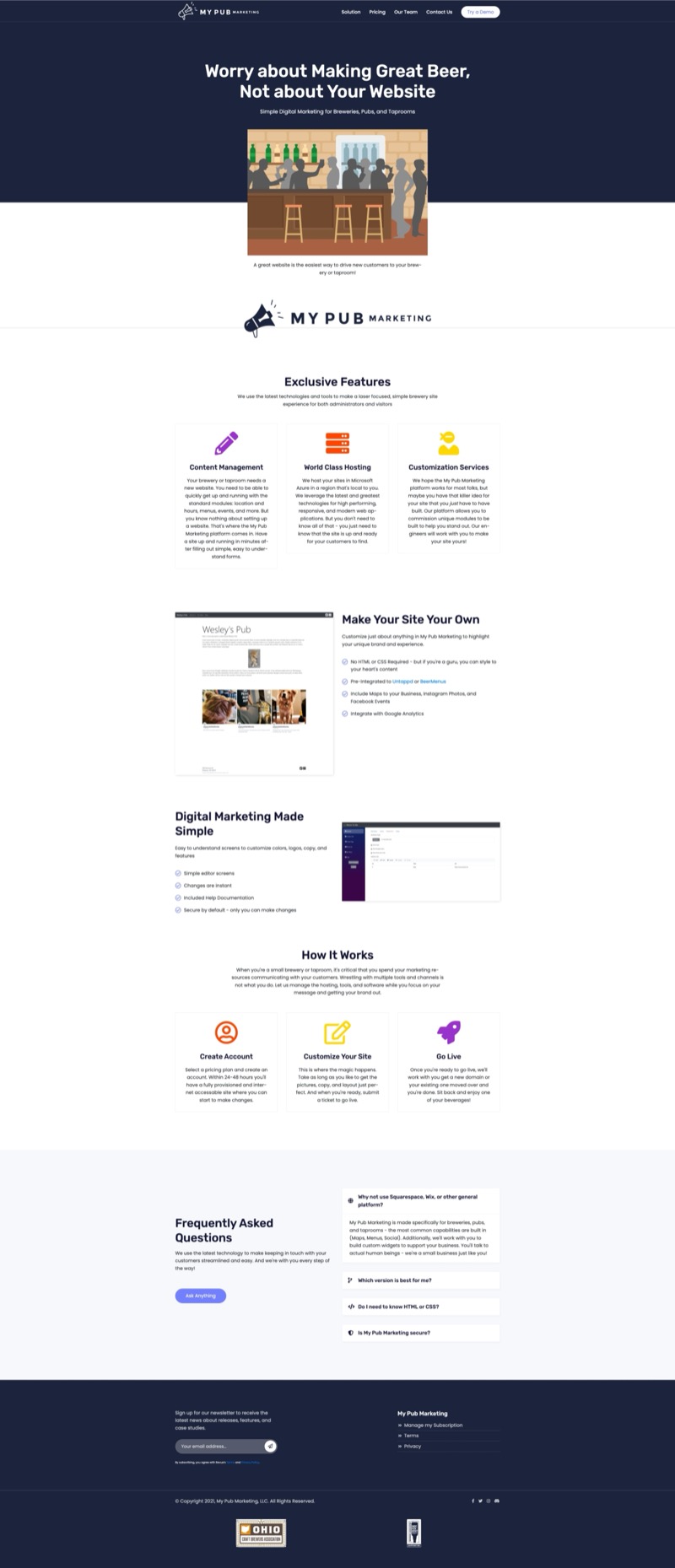
The original My Pub Marketing platform, circa 2021 — built for breweries, pubs, and taprooms.
The platform handled the things that matter to a taproom but don’t exist in a generic site builder: hours and location front and center, tap list integrations with services like Untappd and BeerMenus, social media galleries, map and directions, age verification, and a simple editing interface so a busy owner could update their site between pours.
Behind the scenes, the platform ran on Microsoft Azure — the same cloud infrastructure used by large enterprises. Each customer got a branded website powered by a shared, multi-tenant system that I built and maintained. An admin console called “Barback” let operators manage their content through straightforward forms rather than code. When a customer was ready to go live, I handled the domain setup, hosting, and security.
The pricing was subscription-based: a Standard plan at $39.99 per month and a Premium plan at $79.99 per month, each with a small setup fee. Premium customers got access to custom modules and more consulting hours. Every plan included hosting, security, and support — the kind of things that would normally require a separate vendor or a technical hire.
It was, in essence, a vertical SaaS product with a managed-service layer. Not a generic website builder. Not a full-service agency. Something in between that was designed to be practical and affordable for small operators.
What worked
The concept worked because it addressed real friction. Taproom operators didn’t have time to evaluate hosting providers, compare CMS options, or troubleshoot SSL certificates. They needed a site that looked professional, loaded fast, showed the right information, and didn’t require a developer to update.
The platform delivered on that. Customers could get a branded site provisioned within 48 hours, customize it through guided admin screens, and request go-live support when they were ready. The hospitality-specific defaults — hours display, tap list integrations, social feeds — meant the site was useful on day one, not after weeks of configuration.
The human element mattered too. This wasn’t a faceless SaaS product. Every customer worked with a real person who understood the industry. That combination of technology and personal support built trust in a market that was rightfully skeptical of “marketing solutions.”
What I learned
Running the platform taught me something I hadn’t expected. The website itself was rarely the core problem. It was a symptom.
The operators I worked with didn’t just need a better website. They needed someone who could look at the whole picture — their CRM, their email, their payment processing, their member data, their social presence — and help them build systems that actually drove revenue. A beautiful website with no email capture, no club signup flow, and no way to bring customers back was still leaving money on the table.
I also learned that the craft beverage market was shifting. The brewery boom was maturing. Competition was intensifying. And a growing number of wineries, distilleries, and tasting rooms were facing the same challenges that breweries had faced years earlier: how to turn one-time visitors into repeat customers and club members.
The operators who were winning weren’t just making great product. They were running disciplined direct-to-consumer operations — email campaigns, membership programs, loyalty systems, and data-driven decisions about how to keep guests coming back.
The evolution
Those lessons reshaped the business. Over the next few years, My Pub Marketing evolved from a website platform into a fractional digital operations practice focused on direct-to-consumer wine and hospitality businesses.
The shift was deliberate. Instead of selling a product and handing over the keys, I now work alongside operators as an ongoing partner — managing website operations, email and SMS automation, CRM and member data, social content planning, and club administration. The engagement model is a monthly retainer, and every partnership starts with a fixed-price DTC audit so both sides understand the starting point before any work begins.
The platform didn’t disappear. It evolved too. The technology I originally built for brewery websites became the foundation for a white-label member experience platform — a branded mobile app, member web portal, and admin console that tasting rooms can offer their club members without hiring a development team. The Uncorked Wine Tastings membership platform, built for a wine lounge in Dublin, Ohio, is the clearest example of what that system looks like in practice.
The target market shifted as well. While the business started with craft breweries, the focus today is on independent tasting rooms, wineries, distilleries, wine bars, and small multi-venue operators — businesses with existing DTC sales or membership programs that need enterprise-grade digital systems without the enterprise price tag.
Why it matters for your business
This history isn’t just background. It’s relevant because it means My Pub Marketing didn’t arrive at hospitality from the outside. The business was born in it.
The platform era taught me what small operators actually need from technology — and more importantly, what they don’t. They don’t need a 60-page strategy deck. They don’t need a redesign every quarter. They need systems that work reliably, data they can act on, and a partner who understands that the real business happens at the counter, not on a screen.
Twenty-five years of enterprise digital work at firms like Accenture, EY, and Sitecore gave me the technical foundation. Building and operating My Pub Marketing since 2021 gave me the context to apply it where it actually helps.
If you run a tasting room, a wine bar, or a small DTC operation and you’re wondering whether your digital systems are pulling their weight, that’s the conversation I’m built for. No pitch deck required — just a 30-minute discovery call to look at where you are and figure out what to do next.
