When Does an Independent Venue Actually Need a Custom App vs. a Better Website?
Most independent taprooms, breweries and wine bars asking for a custom app need a faster website they own and one focused staff tool. Three questions to ask before anyone writes code.

It’s a Friday night, and the line at the counter is three deep. Someone wants to know if their club discount applies. Someone else wants to book the back room for a birthday. The point-of-sale screen is thinking about it.
Somewhere in there, the manager has the thought almost every operator has eventually: we need our own app.
I get it. I’ve had the same thought standing behind a counter myself. But most of the time, the app isn’t the fix. The real problem usually sits in two places: a guest-facing website that’s slower and harder to change than it should be, and a staff workflow that makes simple lookups take far too many taps.
Before an independent taproom, brewery, or wine bar spends months and real money on an App Store build, it helps to separate what a custom app actually solves from what a fast website you own already does better.
First, ask what you’d still own
Here’s the question I ask every operator: if you cancelled your hospitality platform tomorrow, what would you still have?
For a lot of venues, the honest answer is not much. The website, the event pages, the party inquiry form, and the guest list all live inside an all-in-one platform that charges every month. The templates are rigid. The inquiry form doesn’t talk to the POS. And getting your own guest data out is harder than it should be.
That’s often where the “we need an app” idea really comes from. It’s not that guests are asking for one. It’s that the current setup feels slow and out of your control, and an app looks like a way to take it back.
An app on top of a platform you don’t own doesn’t fix that. Owning the foundation does: your domain, your website, your guest list, and your inquiry pipeline, in systems you control. That comes with a real tradeoff. Owned tools need someone to maintain them, and you’ll want a clear support plan. But you stop paying rent on things you can’t change.
Guests won’t download an app for a twice-a-month visit
Think about the apps on your own phone. Your bank, your airline, maps, maybe a ride-share. Things you use constantly.
Now picture a guest at your door on a Saturday. To see your tap list, they’d need to open the App Store, wait for a download on spotty cell service, create an account, and confirm an email. Most will just put the phone away and order whatever catches their eye.
For guests, the browser wins. They tap a link from Google Maps, scan a QR code on the table, or click through from Instagram, and your menu, hours, events, and party inquiry form load right there. Nothing to install.
Where custom software earns its keep
The real case for custom software is usually behind the counter, in the hands of your staff. It helps to think in three layers:
1. The guest layer: a fast website you own. Tap lists, menus, hours, events, private party inquiries, and email signups. This belongs in the browser, on a site your staff can update without calling anyone.
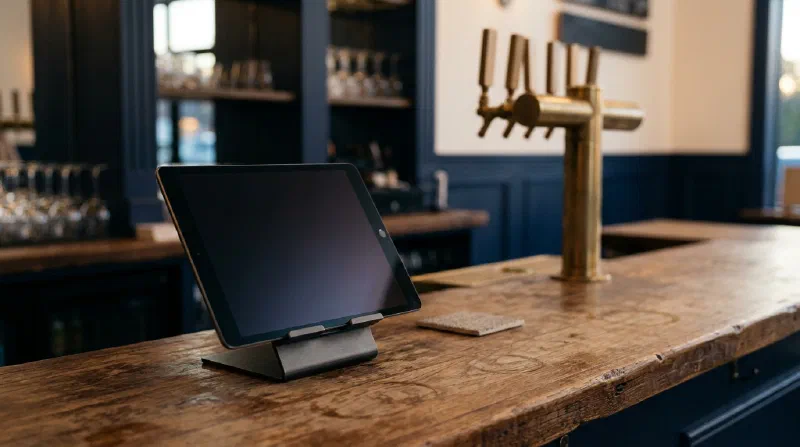
2. The counter layer: purpose-built staff tools. POS systems are built for transactions, not for everything else that happens at the counter. A simple tablet tool can do one job well: look up a regular by phone number, check a club allocation, or redeem an offer, without digging through nested POS menus. Most of the time this can be a web app installed to the tablet’s home screen, and it can keep working when the Wi-Fi drops.
3. The native app: only when you need the phone’s hardware. A true App Store app makes sense when the job needs things a browser can’t do reliably, like talking to Bluetooth or RFID hardware, or triggering location-based alerts in the background. If your idea doesn’t depend on that kind of hardware access, you probably don’t need an App Store app. You need a better website, and maybe a good counter tool.
I say this as someone who has shipped App Store apps and lost at least one long fight with App Store review. Native apps are worth it when they’re needed. They’re also a lot more to maintain than people expect.
Three questions to ask before anyone writes code
1. Does it remove a real bottleneck on the floor? If it doesn’t speed up the counter, stop an inquiry from slipping through, or end double entry between two systems, don’t build it. Software should take work away, not add another screen to manage.
2. Who keeps it running when something changes? Apple, Google, and your POS vendor change things regularly. Custom code belongs to you, but someone has to handle updates and compatibility. If nobody can answer this yet, you’re not ready to build.
3. Could a fast web app do the job instead? Modern web apps can work offline, store data on the device, and install to a home screen. Check that first, before taking on App Store reviews and native releases.
If the answer to the first question is no, or the answer to the third is yes, my advice is not to build the app.
Something to try this week
Write down every system your venue pays for each month. Next to each one, note what you’d lose if you cancelled it tomorrow: your website, your guest list, your event inquiries. That list will tell you more about what to build, keep, or replace than any app pitch will.
At the end of the day, custom software is worth it when it’s aimed at a real problem. Give guests a fast, simple experience in their browser, own the systems underneath it, and save custom builds for the tools that keep your floor moving.
Related Posts
Want a second set of eyes on your stack?
No sales script. We'll talk through your stack, your costs, and whether an audit makes sense.
Book an Intro CallThe Operator Note
One pattern. One quick win. Monthly.
No fluff, no agency-speak. Just what I'm seeing across tasting rooms and what's actually working.
You're in. First issue lands in your inbox soon.
