Why Your Tasting Room Email List Isn't Driving Repeat Visits (And How to Fix It)
Most tasting rooms collect email addresses and then wonder why nobody comes back. The problem isn't your list size — it's what happens after someone signs up.

Most tasting rooms have an email list. Almost none have an email program.
There’s a difference. A list is a collection of addresses. A program is a system that turns those addresses into return visits, wine club signups, and repeat purchases — automatically, without anyone having to remember to hit send.
If you’ve ever looked at your open rates and thought “not bad,” but your tasting room isn’t filling up with returning faces, the problem isn’t the email. It’s what the email is asking people to do, and when.
The most common mistake: the newsletter as announcement board
Most tasting room email strategies are built around announcements. New vintage. Upcoming event. Holiday hours. These are useful, but they’re not a program — they’re a bulletin board. And bulletin boards don’t build relationships.
Returning guests don’t come back because you told them about a new Cab. They come back because your venue is already in their head as a place they want to be. Email’s job is to put it there — and keep it there — between visits.
That requires a different kind of message than “Join us for Spring Release Weekend.”
What a tasting room email program actually looks like

A real email program has three layers:
1. An onboarding sequence
The moment someone signs your signup sheet or submits their email at the counter, they should automatically receive a short series of messages — not a newsletter blast, but a sequence designed to turn a first-time visitor into someone who knows why they’d come back.
This might be:
- A welcome email that tells them something interesting about the venue they probably didn’t hear on the floor
- A follow-up three days later highlighting something specific — a wine they may have tried, a member benefit they didn’t know existed, a behind-the-scenes detail
- A soft invite one week out: “If you’d like to come back and go deeper, here’s how.”
Three emails. No design budget needed. Just specificity and timing.
2. A behavioral trigger or two
Most email platforms — even Mailchimp — can send messages based on what someone does or doesn’t do. If someone clicked on your wine club page but didn’t sign up, that’s a signal. If someone hasn’t opened an email in 90 days, that’s a signal too.
A simple win-back sequence — two or three emails sent automatically to lapsed contacts — consistently outperforms your next newsletter in terms of repeat visits and click rates. Not because it’s clever, but because it’s timed to the moment when it might actually matter.
3. Revenue-linked messages
Your email list should be connected to what makes you money. That means at least one pathway from email to club signup, at least one event email that links to actual registration (not just “come in”), and a system that lets you see whether the people who received the email showed up.
Without that connection, email is just noise that happens to come from your address.
For a deeper look at the specific sequences that keep wine club members engaged year-round, see Wine Club Email Automation: What Independent Wineries Can Learn from Enterprise Marketing.
Why most tasting rooms get stuck here
The honest reason most email lists go quiet is operational: someone was supposed to send something and didn’t, or the platform is technically connected to something but nobody knows how, or the signup sheet lives in a drawer and gets entered into the system whenever someone has a spare hour.
This isn’t a content problem. It’s a systems problem.
The fix is to remove the manual steps — not the human touch, just the friction that keeps the program from running. When a guest signs up, the sequence should start on its own. When a contact goes 60 days without opening an email, the win-back should go out without a staff member remembering to set it.
That’s not a complicated build. It takes an afternoon to wire up correctly and then it runs.
Where to start
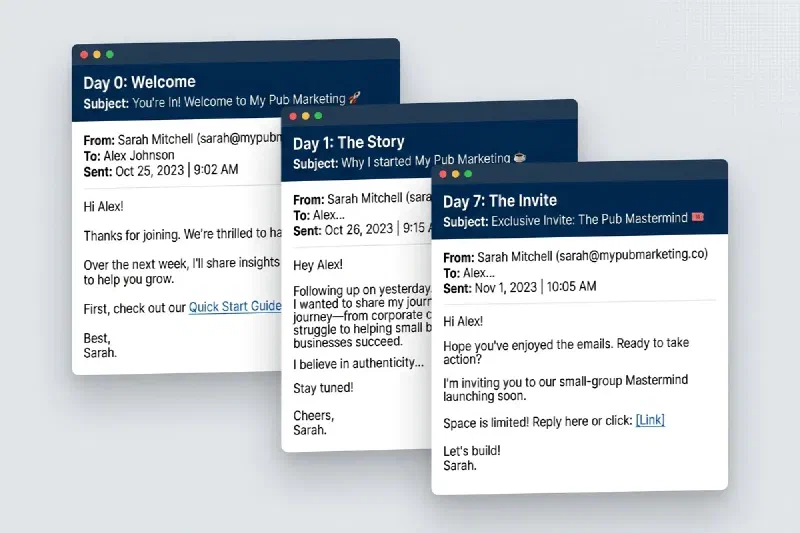
If your email program is currently “we send a newsletter when we have time,” start with one thing: an automated welcome sequence. Write three short emails. Set them up to send on Day 0, Day 3, and Day 7. Don’t design them — just send them as plain text from you personally.
Then measure one thing: did the people who received those three emails come back within 90 days at a higher rate than the people who didn’t?
That’s the question your email program should be answering. And once you have that answer, you’ll know exactly what to build next.
If you want a plain-language picture of where your current email setup stands, the Free 5-Minute Digital Leak Check covers this along with the rest of your digital operation.
The Operator Note
One pattern. One quick win. Monthly.
No fluff, no agency-speak. Just what I'm seeing across tasting rooms and what's actually working.
You're in. First issue lands in your inbox soon.
