You Can't Build a Bar on Rented Land
Most tasting rooms quietly lose 15% of their repeat revenue between visits. Here's the three-channel digital stack that stops the leak — built for independent taprooms and wineries.

It’s a pattern we all recognize in the tasting room world: a packed Instagram feed, a loyal local following, hundreds of likes on last Saturday’s pour — and a slow Tuesday that nobody can explain.
The likes didn’t predict it. Neither did the follower count.
I’ve run these same follow-up flows at the tasting room I work — repeat visits increased 15% in 90 days. Not from more posting. From owning the line to guests instead of renting it from an algorithm.
Here’s the hard truth: social media is not a revenue system. It’s a discovery tool. And if it’s the center of your digital strategy, you’re building your business on land you don’t own.
The Rented Attention Problem
Every post you publish on Instagram, Facebook, or TikTok is rent. The platform decides who sees it. The algorithm resets every week. And when the platform changes its rules — and it will — your reach changes overnight without warning.
It’s happened to operations that spent years building an audience, only to see organic reach drop by half after a policy update they never saw coming. The guests were still out there. The relationship just got cut off.
That’s the cost of rented attention. You’re not building an audience. You’re borrowing one.
What Guests Actually Need Before They Visit
Before a guest commits to coming in on a Friday night, they want answers to four specific questions:
- Are you open right now?
- What’s actually pouring tonight?
- Is there anything worth coming for?
- Can I get a spot without showing up and hoping?
Social media is fundamentally bad at answering these. A post from three days ago doesn’t tell them the tap list changed. A story from last week doesn’t confirm tonight’s hours. An Instagram bio link that goes to a homepage with no live information sends them somewhere else.
Your website is the decision engine. When a guest has intent — when they’re sitting on the couch on a Thursday night deciding whether to go out — they open a browser, not an app feed. If your site makes that path frictionless, they come in. If it doesn’t, they pick somewhere that does.
Social Has a Real Job. It’s Just Not the One Most of Us Give It.
This isn’t an argument against social media. It’s an argument for using it correctly.
Social creates awareness and validation. A guest discovers you on Instagram, sees real people enjoying your space, and decides you’re worth a visit. That’s the job. It does that well.
What it can’t do is convert that interest into a visit on a specific night, bring a guest back three weeks later, or tell you which of your regulars hasn’t been in since October.
That’s the website’s job. And the app’s job.
The Three-Channel Stack That Actually Works
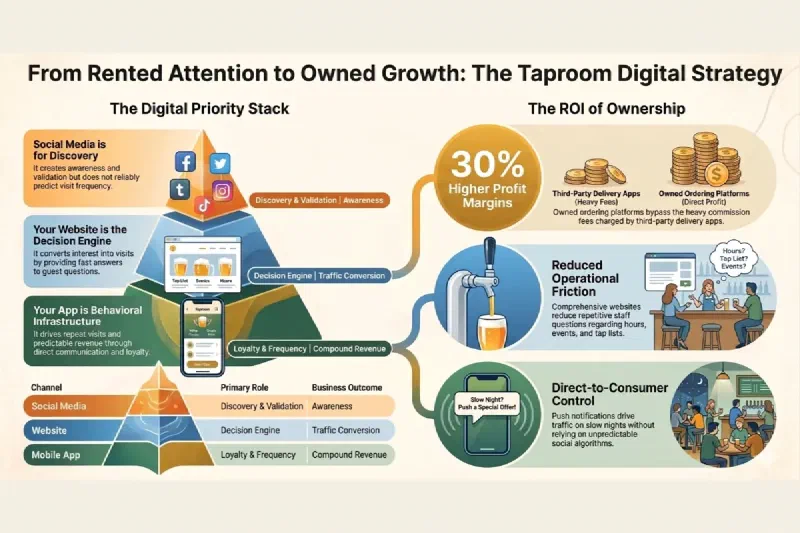
The operations with the most predictable revenue aren’t necessarily the most active on social. They’ve built a stack where each channel has a clear, distinct role:
Social media is for discovery and validation. New guests find you, confirm you’re real, and decide you’re worth a visit. That’s it. Don’t try to run your tap list through Instagram stories.
Your website is the decision engine. It converts “maybe tonight” into “we’re going.” Fast answers, current information, frictionless path from interest to visit. If guests are DMing you to ask your hours, the site is failing at its job.
A custom mobile app is behavioral infrastructure. Push notifications on a slow Wednesday. Loyalty that doesn’t require a punch card or a staffer to track. High-touch communication with your regulars without asking an algorithm’s permission. This is where repeat visits get built.
The compound effect matters here. Social brings them in once. The website brings them back again. The app turns them into regulars.
The 30% That Doesn’t Go to Delivery Apps
Operations that have moved their wine club and membership management onto owned platforms rather than third-party apps see margins that look completely different. Delivery and ordering platforms take their cut — typically 15–30% per transaction — because they own the relationship with the guest.
When you own the channel, you own the relationship. You communicate directly. You don’t pay a commission. You know who your best guests are and what they order.
That’s not a technology argument. It’s a business ownership argument.
The Question Worth Asking Right Now
If Instagram disappeared tomorrow, could you still reach your 200 most loyal guests? Could you drive traffic on a slow night without relying on an algorithm to decide who sees your post?
If the answer is no, the channel mix needs rebalancing.
The goal isn’t to abandon social. It’s to stop treating it like the foundation when it’s really just the front door.
Your website converts. Your app retains. Social finds new guests and reminds everyone you exist.
Build the stack in that order, and slow Tuesdays get a lot less common.
My Pub Marketing runs the digital engine for independent wineries, taprooms, and craft beverage brands — custom apps, CRM, email, club management, and website strategy. Start your 5-minute digital leak check →
The Operator Note
One pattern. One quick win. Monthly.
No fluff, no agency-speak. Just what I'm seeing across tasting rooms and what's actually working.
You're in. First issue lands in your inbox soon.
